Why Digital Menu Boards Fall Out of Sync
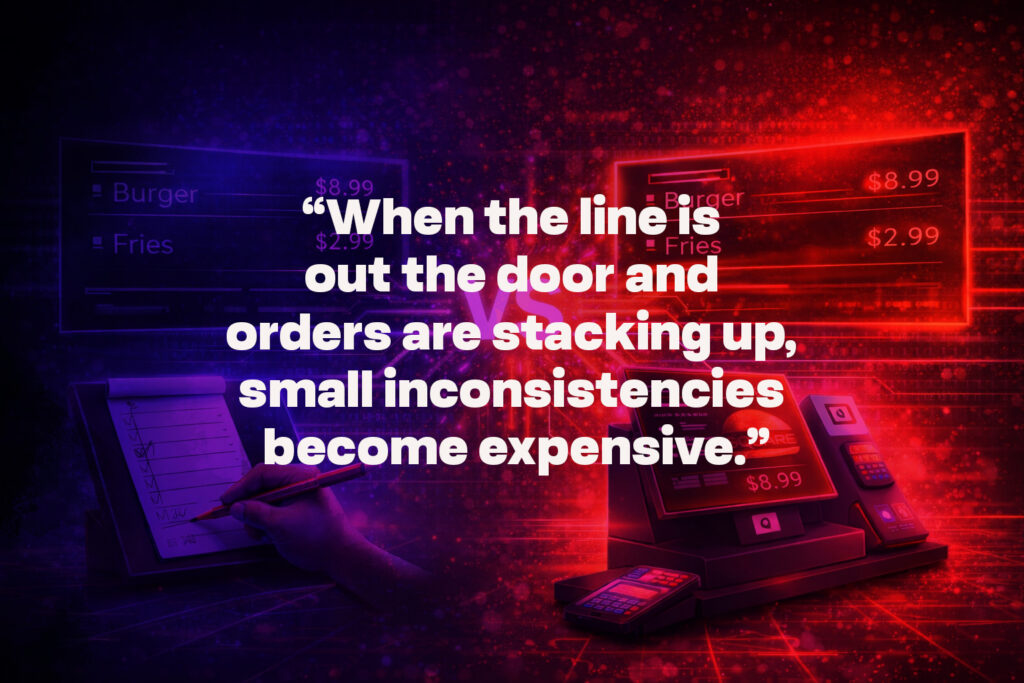
Most menu inaccuracies are operational, not technological. Common causes include:
Manual updates.
Someone has to remember to update the screen after changing the POS.
Spreadsheet pricing.
Pricing is managed outside the POS, then copied into signage manually.
Location-by-location changes.
Multi-unit brands rely on individual managers to execute updates correctly.
Human error.
A missed decimal. An outdated promo. An item that should have been removed.
When signage is disconnected from the POS, every update becomes a task. Tasks get delayed. Delays create inconsistencies.
Static processes struggle to keep pace with real-world restaurant conditions, where pricing, availability, and promotions change constantly. Digital menu boards connected to POS systems can eliminate these delays by updating information automatically. Learn how POS-connected menu boards stay accurate.
What POS Integration Actually Means
POS integration is not just “compatible with.” It means direct synchronization between your point-of-sale system and your digital signage platform.
In practical terms, that includes:
- A live connection to your POS database
- Automatic content synchronization
- Real-time updates across all connected screens
Your POS becomes the single source of truth. Digital menu boards simply reflect that data.
No duplication. No re-entry. No second system to maintain.
POS integration ensures pricing, availability, and menu changes update instantly across displays, reducing manual work and improving operational efficiency.
How Real-Time Menu Updates Work
Once POS integrated digital menu boards are connected, updates follow a clear logic:
Price change → screen change
Adjust pricing in the POS and the updated price displays automatically.
Inventory change → item removal
When an item sells out or is marked unavailable, it disappears from the menu board.
Promotion change → activation
Start or end a promotion in the POS, and digital signage activates or deactivates accordingly.
The screens mirror operational reality without requiring additional labor.
Digital signage systems can also schedule promotions and automatically adjust menus based on time of day, inventory levels, or campaign timing, ensuring messaging remains relevant.
Operational Benefits
The impact goes beyond visual accuracy.
Reduced staff intervention
Managers no longer need to manually edit menus during busy shifts.
Fewer mismatches
Customers see what is available and correctly priced.
Faster peak-hour performance
When menus are accurate, staff spend less time explaining discrepancies or issuing overrides.
Accuracy supports speed. Speed supports revenue.
Real-time menu accuracy improves ordering efficiency and customer experience, helping restaurants process orders faster and reduce confusion at the counter.
Is POS-Integrated Digital Signage Worth It?
For single-location restaurants with infrequent updates, manual systems may feel manageable.
For QSR brands, multi-location operators, or restaurants running frequent promotions, the math changes quickly.
The more updates you make, the more risk you introduce when systems are disconnected.
POS integrated digital menu boards reduce that risk by aligning operations and communication in real time. Instead of managing two systems, you manage one.
If your screens are not connected to your POS, you are maintaining parallel processes. And parallel processes eventually drift.
If they are integrated, your menu works the same way your POS does: automatically, accurately, and at scale.
Digital menu boards enable instant updates across locations, eliminating delays, printing costs, and errors associated with static signage.
If you want to explore how this connects with broader dynamic digital menu boards, the integration layer is where the operational impact begins.